Frankincense and Myrrh: The Temple's Ancient Pharmacy, Now Backed by Science
Frankincense and myrrh held central roles in the Temple service, and modern research now helps explain why. Myrrh acted as a potent antimicrobial, frankincense as a calming agent that works on the brain.
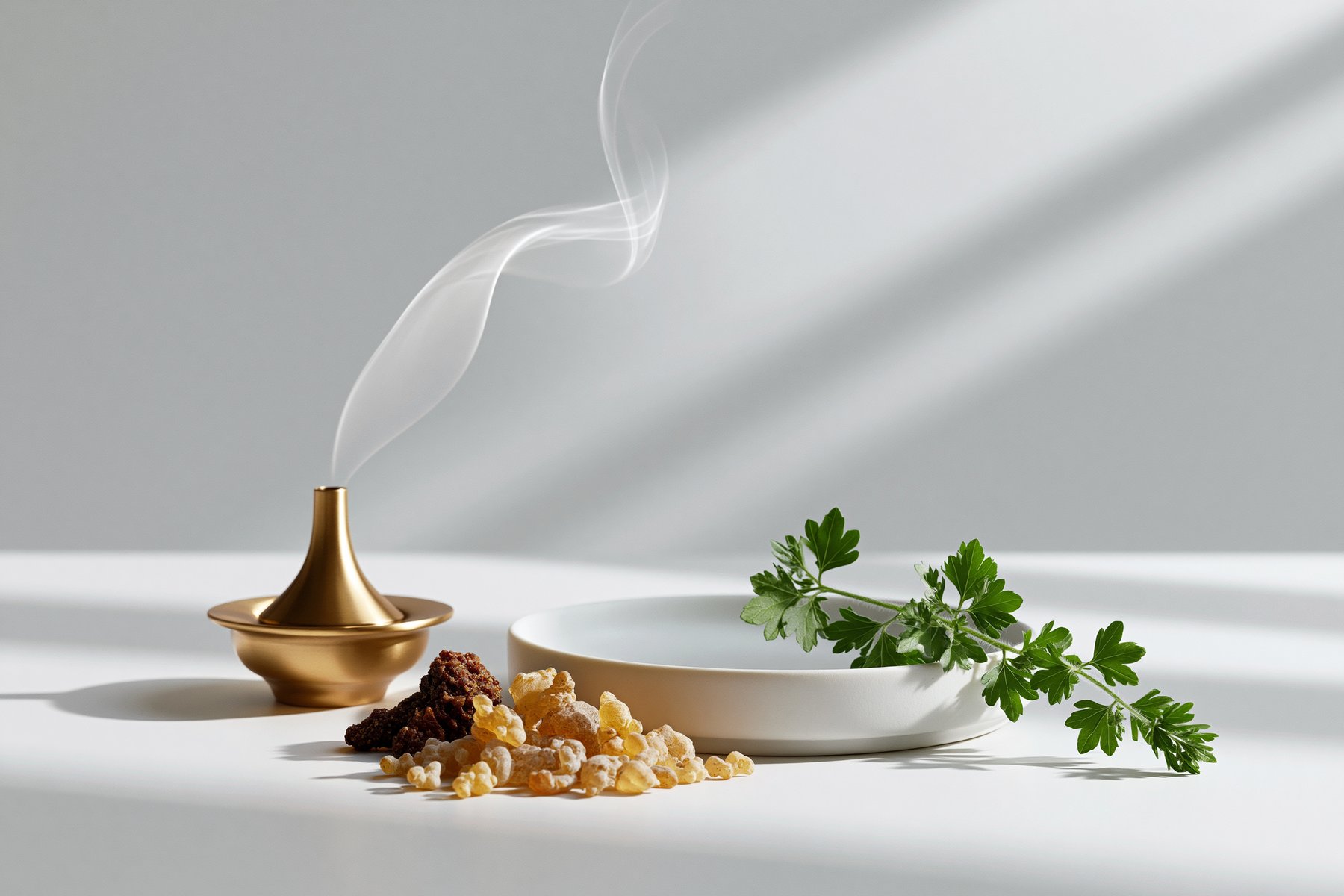
Frankincense and myrrh were not chosen for the Temple by chance. In the instructions for the sanctuary, frankincense (levonah) is named as part of the sacred incense, and myrrh (mor) as the first spice of the holy anointing oil (Exodus 30). Thousands of years later, modern research is beginning to explain what the ancients appear to have known through experience. These two resins have real, measurable effects. Myrrh is a powerful antimicrobial, and frankincense a calming agent that works directly on the brain.
The Temple’s two sacred aromatics
Exodus 30 sets out two distinct preparations. The holy anointing oil (shemen ha-mishchah) begins with “pure myrrh” (Exodus 30:23). The incense (ketoret), burned morning and evening, includes “pure frankincense” (Exodus 30:34). One was used to anoint; the other filled the space with smoke and scent.
It is worth picturing the setting. The Temple was a place of animal sacrifice, the handling of meat, and the hygiene limits of the ancient world, an environment where contamination was a constant risk. Seen this way, the two resins map remarkably onto two practical needs: keeping things clean, and shaping a state of mind.
Myrrh: an antiseptic before antiseptics
Modern laboratory research gives myrrh real credibility as a cleansing agent. Studies of Commiphora myrrh show antimicrobial activity against both gram-positive and gram-negative bacteria, and traditional use as an antiseptic, astringent, and wound treatment. One finding stands out. An antibiotic compound isolated from myrrh preferentially kills nongrowing, dormant bacteria, the very cells that conventional antibiotics struggle to reach.
In other words, the resin chosen for the anointing oil, applied to surfaces, vessels, and people, behaved in effect like an early disinfectant. (This evidence is largely from in-vitro studies, not clinical trials.)
Frankincense: calm that acts on the brain
Frankincense carries a different kind of power. It contains incensole acetate, and in research led by Moussaieff and colleagues, this compound activates TRPV3 channels in the brain, producing anxiety-reducing and antidepressant-like effects in animal models. The same researchers traced Boswellia resin in a review pointedly titled “from religious ceremonies to medical uses.”
That gives a genuine biological mechanism for something incense has been used to do for millennia: quiet the nervous system and open a calm, inward, contemplative state, ideal for prayer and meditation. As with myrrh, much of this work is still preclinical, but it points in a consistent direction.
Wisdom, coincidence, or science?
Perhaps it was trial and error refined over generations, or perhaps something more. Either way, the choices encoded in Exodus 30 line up neatly with what the laboratory is only now describing: myrrh to purify, frankincense to quiet the mind. Real magic, coincidence, or well-grounded science that simply took us a long time to trace?
Frequently asked
Where are frankincense and myrrh mentioned in the Bible?
Both appear in Exodus chapter 30, in the instructions for the sanctuary. Frankincense (levonah) is named as part of the sacred incense, the ketoret (Exodus 30:34), and myrrh (mor) is the first spice of the holy anointing oil (Exodus 30:23).
Does myrrh actually have antibacterial properties?
Laboratory studies show Commiphora myrrh has antimicrobial activity against a wide range of bacteria and fungi. One notable finding is that an antibiotic compound in myrrh preferentially kills dormant (nongrowing) bacteria, a property not seen in commercial antibiotics. Most of this evidence is from in-vitro (lab) studies.
How does frankincense create a feeling of calm?
Frankincense contains incensole acetate, which research shows activates TRPV3 channels in the brain and produces anxiety- and depression-reducing effects in animal studies. This offers a plausible biological basis for the calm, meditative state long associated with burning incense. The evidence so far is largely preclinical.
References
- Exodus 30:23, myrrh in the holy anointing oil · Exodus, Hebrew Bible
- Exodus 30:34, frankincense in the sacred incense (ketoret) · Exodus, Hebrew Bible
- Incensole acetate, an incense component, elicits psychoactivity by activating TRPV3 channels in the brain (Moussaieff et al., 2008) · The FASEB Journal / PubMed (NIH)
- Boswellia resin: from religious ceremonies to medical uses, a review of in-vitro, in-vivo and clinical trials (Moussaieff & Mechoulam, 2009) · Journal of Pharmacy and Pharmacology
- Antibiotic in myrrh from Commiphora molmol preferentially kills nongrowing bacteria · National Library of Medicine (PMC)
- Commiphora myrrha gum resin extract: antimicrobial and fibroblast wound-healing activities · PubMed (NIH)